Last week at the INL Critical Materials Partner Forum in Idaho Falls, ID, leaders across government, industry, and academia convened to collaboratively address the critical material challenges impacting the nation. One of the most resonant takeaways came from the keynote discussions, which highlighted that the marketplace, not just discovery, is the most critical element in securing our supply chain. To build a truly resilient domestic pipeline, we must align extraction capabilities with market realities. At Coactive Science, our perspective on this challenge is clear: the data required to secure the domestic U.S. critical metal supply chain already exists.
However, leveraging that data requires moving beyond standard satellite imagery. We utilize hyperspectral mapping and active sampling to build a comprehensive Geospatial-to-Geochemistry Foundation Model. This model fundamentally shifts the exploration paradigm. Instead of treating raw feedstock as a massive uncertainty that requires years of physical exploration to validate, our AI treats the feedstock as a known variable. By mapping precise geochemical signatures across vast search spaces, such as the 2,000+ mining tailing ponds we have already investigated, we can definitively quantify the inventory available above and below ground.
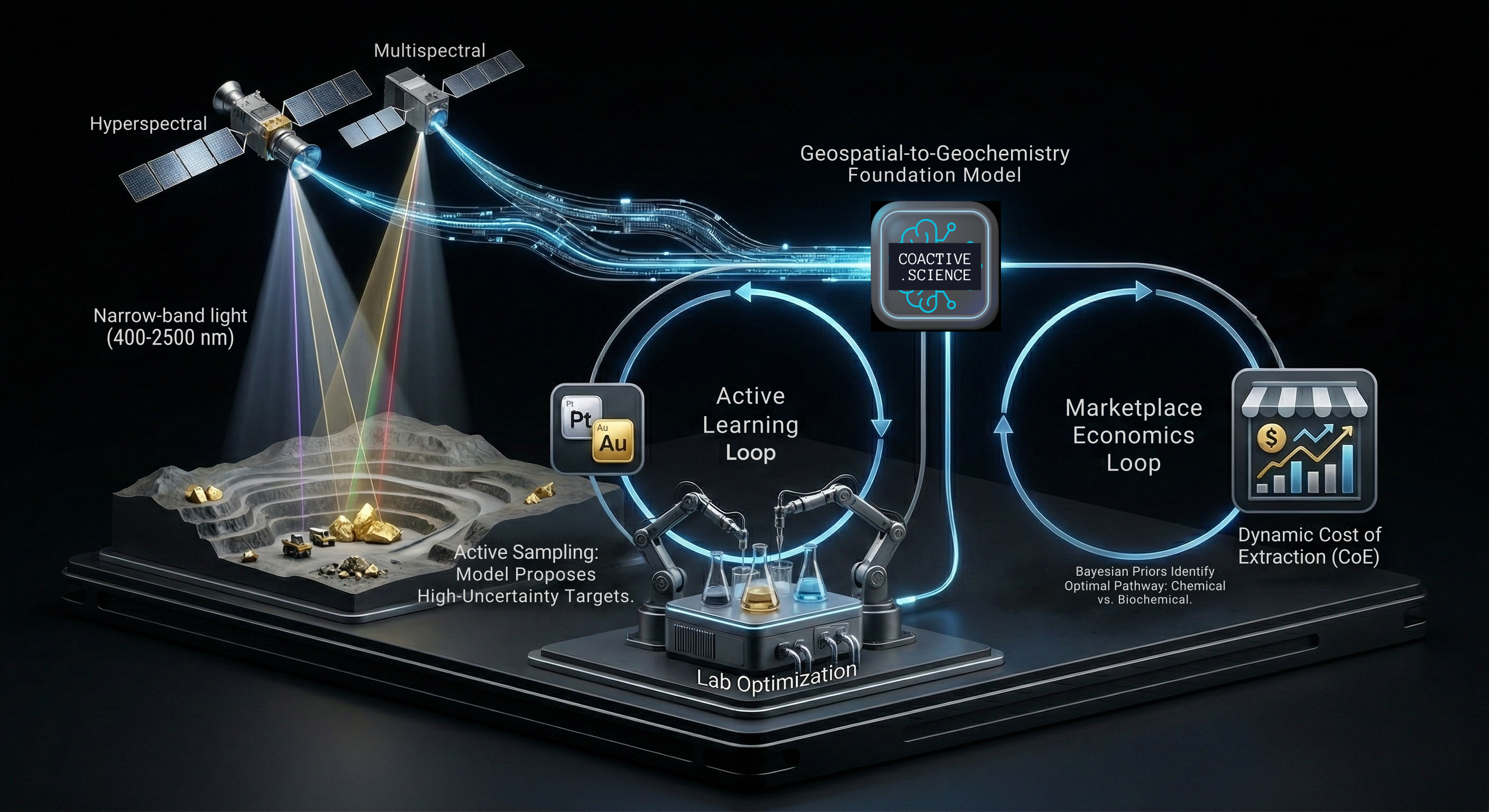
Knowing where the minerals are is only the first step; the true bottleneck is determining how to process them profitably. This is why the Critical Materials Innovation Hub and recent DOE funding for feedstock processing focus heavily on the transition from raw inventory to final metal recovery. Because our model treats the feedstock as a known variable, we are able to assign a dynamic Cost of Extraction (CoE) to various processing methods. By integrating Bayesian priors into our active learning loop, the AI identifies the optimal, multi-modal path, whether chemical, biochemical, or hybrid from raw inventory to final metal recovery. This ensures the most economically and environmentally viable process flow is selected before a single agent ever enters the lab.
Ultimately, this data-driven approach directly serves the marketplace. By identifying high-concentration ore and optimizing the extraction pathways, we can optimize capital allocations for all stakeholders. This creates a reliable architecture for end-to-end US supply chain solutions, ensuring that bulk purchasers have the secure, domestically sourced materials they need to drive the next generation of American industry and defense.